

Why 1 In 3 U.S. Companies Are Replacing Soundproofing Wall Panels With Office Pods In 2026?
Help U.S. office buyers compare soundproofing wall panels and office pods clearly, without product hype. The goal is to show what each option actually does, where each one fails, and which office noise solution makes sense for focus work, private calls, and hybrid teams in 2026.
Key Takeaways
Wall panels help reduce room echo by absorbing sound reflections, but they do not provide true privacy.
- Office pods create enclosed, quiet spaces for calls, meetings, and focused work.
- Acoustic panels and office pods solve different problems and should not be viewed as direct alternatives.
- While panels improve the acoustics of a room, pods are designed to protect the individual from surrounding noise.
- Noise remains a major challenge in open-plan offices, affecting concentration, communication, and productivity.
- Office pods often deliver greater long-term value because they are movable, self-contained, and require no major renovations.
-
A sales team takes calls beside the design team. HR uses the same open space for confidential conversations. Managers jump between video meetings while nearby staff try to finish focused work.
That is the normal U.S. office problem now.
Many companies first try soundproofing wall panels because they look simple. Add panels to the walls. Reduce noise. Move on. But soundproofing wall panels do not work the way many buyers expect. They help with echo. They do not stop voices from traveling across the room.
That difference matters when privacy, focus, and call quality are the real issues.
What’s The Difference Between Soundproofing Wall Panels And Office Pods?
Soundproofing wall panels absorb echo and reduce reverberation across a room. They make speech sound cleaner inside that room, especially in spaces with glass, drywall, concrete, or exposed ceilings.
They do not block sound like a sealed wall. They do not create visual privacy. They do not isolate one worker from another.
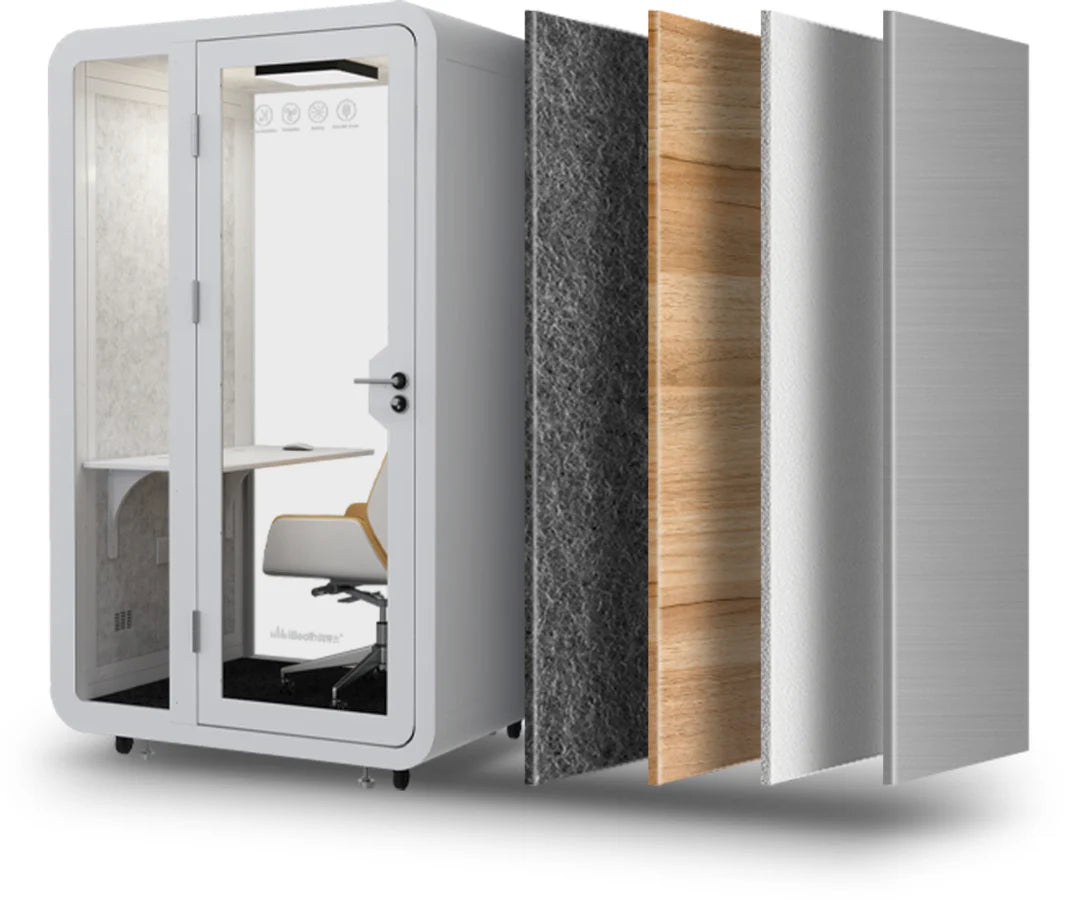
Office pods work differently. A pod is a self-contained acoustic space placed inside an existing office. It gives one person, two people, or a small team a quiet area for calls, video meetings, and focused work without construction.
That is the direct answer.
Panels improve the room. Pods protect the person using the space.
StreamingPods is seeing this shift firsthand as U.S. workplaces look for modular office privacy solutions that solve daily noise problems without turning the office into a construction site.
Key Insights
Open-plan offices often sit around 60–65 dB, which is loud enough to interfere with concentration during detailed work.
A single interruption can cost around 23 minutes before a worker fully returns to the original task. At $35 per hour, that makes one interruption worth about $13.50 in recovered focus time.
The office pod market is growing because hybrid teams need private places for Zoom calls, client conversations, and heads-down work inside shared offices.
Sound proofing panels for walls usually improve acoustics by reducing reflections. Quality office pods can reduce outside noise by 25–35 dB, depending on build, placement, and model.
StreamingPods lists 30.9 dB noise reduction on its standard units. That is the difference between a noisy open office and near-library quiet.
What Soundproofing Wall Panels Actually Do
Soundproofing wall panels are better described as acoustic panels. Their job is sound absorption.
When people talk in a room, sound waves hit hard surfaces and bounce back. That creates echo, flutter, and a messy sound field. Noise reducing wall panels absorb part of that reflected energy so the room feels less harsh.
That helps in meeting rooms, podcast spaces, training rooms, and open offices with too many hard surfaces.
But acoustic panels vs soundproofing is where many buyers get misled. Sound dampening panels for walls do not seal gaps. They do not add enough mass to stop voices. They do not prevent someone ten feet away from hearing a private call.

What Office Pods Actually Do
An office pod creates a quiet work zone inside a larger office. It is enclosed, movable, and designed for daily use.
A good office pod for focus work solves three problems at the same time: sound, privacy, and usability. Staff can step inside for client calls, interviews, one-on-one meetings, or focused tasks without booking a full meeting room.
StreamingPods lists 30.9 dB noise reduction for its units. In plain language, that can take the experience from a loud open office around 65 dB to a much quieter space close to 35 dB.
That is why an acoustic privacy booth often works better than panels for real work. The pod does not just soften the room. It separates the user from the noise around them.
Modular units like those from StreamingPods are built for U.S. office environments: drop-in setup, no renovation, and daily use across teams.

Difference Between Soundproofing Wall Panels Vs Office Pods: 6 Key Factors
|
Factor |
Wall Panels |
Office Pods |
|
Noise reduction |
5–15 dB in many room-treatment setups |
25–35 dB in quality pod setups |
|
Full acoustic privacy |
No |
Yes |
|
Visual privacy |
No |
Yes |
|
Installation required |
Moderate |
Minimal |
|
Portability |
Low |
High |
|
3-year ROI |
Limited when privacy is the issue |
Strong when calls and focus work drive the need |
The verdict is simple. Panels are better when the room sounds bad. Pods are better when people need private space.
That does not make it either-or. Many U.S. offices use panels for room acoustics and one or more pods for individual privacy.
For team planning, read How to choose the right office pod size for your team.
The Smart Features Wall Panels Will Never Have
Today’s office pods have moved well beyond acoustic enclosures. They are fully equipped workstations.
Wall panels sit on a wall. A pod supports the full work session.
Ventilation
Fresh air supply keeps the space usable during long meetings and back-to-back video calls. Without airflow, even a quiet pod becomes uncomfortable quickly.
Adaptive Lighting
Built-in lighting helps with video calls, reading, and focused work. Users do not need to sit under harsh overhead lights or depend on the room around them.
Built-In Charging
Power outlets, USB access, USB-C access, and wireless charging keep devices ready inside the booth. That matters when the pod is used all day by different people.
Ergonomic Setup
A practical pod includes a desk, seating, interior surfaces, magnetic walls, and storage hooks. These small details decide whether staff actually use it.
StreamingPods builds these core features into its modular office pods as standard, not as paid upgrades.
Spec callout: StreamingPods standard units list 30.9 dB noise reduction.
Total Cost Of Ownership — Wall Panels Vs Office Pod Over 3 Years
Facilities teams do not buy noise products only once. They live with the choice for years.
Wall panels usually involve product cost, layout planning, wall mounting, labor, cleaning, and possible replacement if the office layout changes. If the office later moves, panels often stay behind or need another installation budget.
Pods have a clearer cost structure. Buyers compare unit price, delivery, setup, accessories, and possible relocation.
The hidden cost is productivity. If panels reduce echo but employees still leave the room for private calls, the company has not solved the real problem.
3-Year Cost Comparison
|
Cost Area |
Wall Panels |
Office Pod |
|
Upfront material cost |
Lower |
Higher |
|
Installation labor |
Usually needed |
Usually low |
|
Construction disruption |
Low to moderate |
Very low |
|
Privacy value |
Weak |
Strong |
|
Relocation value |
Low |
High |
|
Productivity protection |
Limited |
Higher |
|
Best use |
Room-wide echo control |
Calls, focus, hybrid work |
Office noise is not only a comfort issue. Oxford Economics workplace research has shown that workers connect noise control with productivity, focus, and fewer errors.
For more detail, read Full comparison of soundproofing materials vs office pods.
Lead Magnet: Download: Office Noise Solution Checklist — 7 Questions To Ask Before You Buy Panels Or A Pod
How To Decide What Your Office Actually Needs
Step 1: Identify The Primary Noise Problem
Is the issue echo, or is it speech privacy?
If the room feels loud and harsh, panels may help. If people can hear private calls across the office, panels will not solve it.
Step 2: Count How Many People Need Isolation At The Same Time
One busy sales floor may need several small booths. A leadership team may need a two-person or four-person pod for private conversations.
Step 3: Decide Whether The Problem Is Room-Wide Or Individual
Room-wide noise calls for acoustic planning. Individual call and focus issues call for a soundproof booth for office use.
Step 4: Calculate The Full Cost
Include installation, downtime, accessories, maintenance, relocation, and lost focus. The cheapest product on day one is not always the cheaper decision over three years.
Step 5: Request Quotes From 2–3 U.S. Pod Providers
Compare size, sound rating, lead time, warranty, shipping, setup, and support.
You can start with Streaming Pods if you want a quote based on office size, headcount, and use case.
Lead Magnet: Download: Office Noise Solution Checklist — 7 Questions To Ask Before You Buy Panels Or A Pod.
Conclusion
Soundproofing wall panels and office pods solve different problems.
Panels treat a room. Pods protect a person.
For U.S. offices where privacy, focus, and productivity are the real goals, the data in 2026 points toward modular office pods as the stronger long-term investment. The right answer is not the cheapest or most visible product. It is the solution that matches the actual noise problem, team size, and workflow.
StreamingPods offers soundproof office pods, phone booths, glass office pods, and meeting pods for companies that need open office noise reduction without renovation.
FAQs
Are Soundproofing Wall Panels Enough For Private Calls?
No. They can reduce echo, but they do not create a private booth. If other people can still hear the conversation, the privacy problem remains.
Do Office Pods Need Permits?
Most modular office pods are non-permanent units, so they usually do not need permits. Buyers should still confirm local building, fire, and workplace rules before ordering.
Can Panels And Pods Be Used Together?
Yes. This is often the best setup. Panels improve the shared room. Pods give people private space for calls, meetings, and focus work.
What Is An STC Rating For Office Partitions?
STC rating office partitions measure how well a partition reduces airborne sound transfer. Higher ratings usually mean better sound blocking, but real performance also depends on seals, doors, glass, gaps, and installation quality.
Which Option Works Better For Hybrid Workspace Acoustics?
Office pods usually work better for hybrid workspace acoustics because they support video calls, private meetings, and focused work in one place. Panels help the room sound better, but they do not solve call privacy by themselves.
